
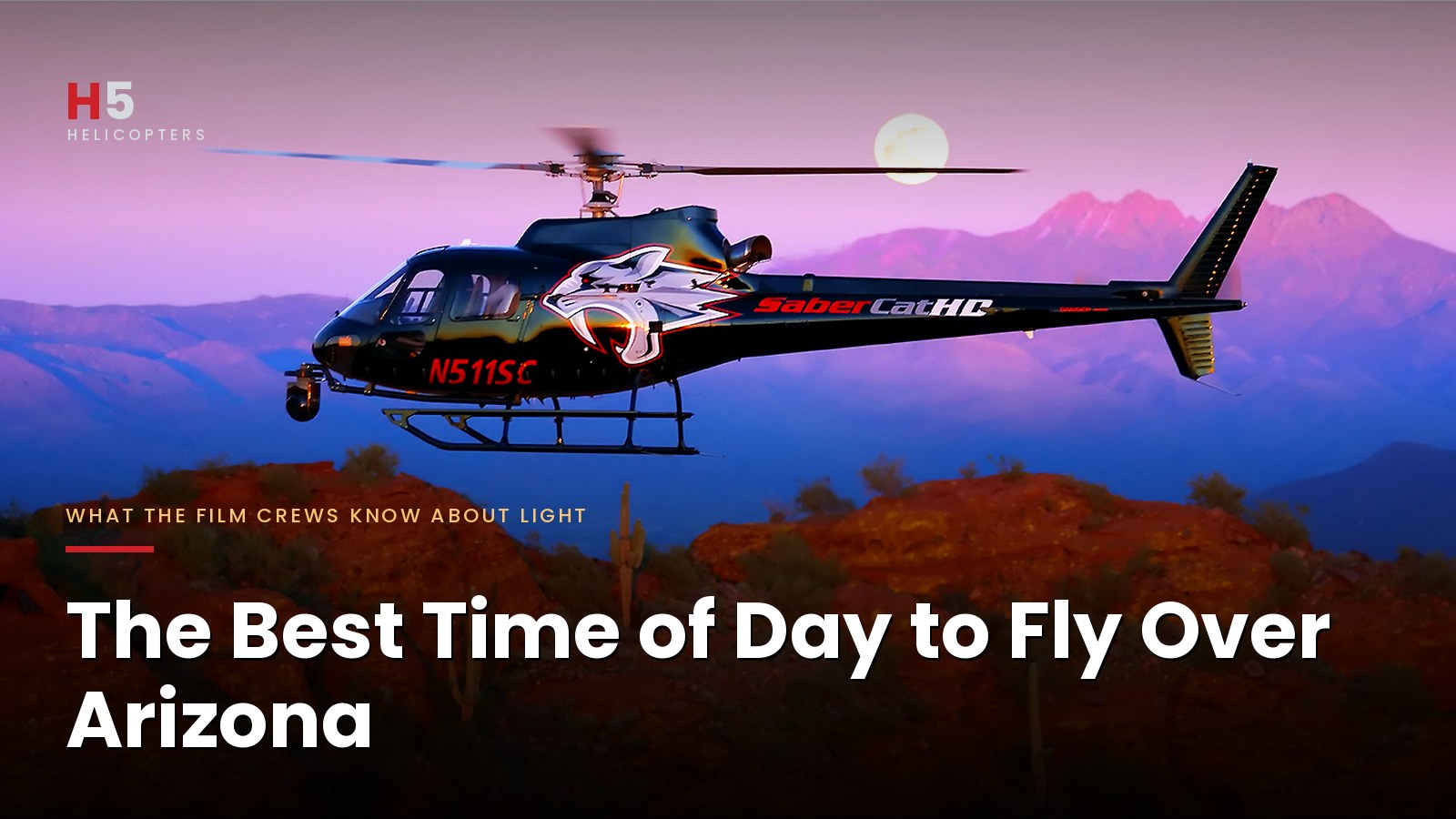
Every aerial film crew we have ever flown wants the same two hours of the day. Not the middle. They want first light after sunrise or last light before sunset, and they will rebuild a shooting schedule to get it.
The best time of day to fly over Arizona is the first two hours after sunrise or the last two hours before sunset, when a low sun angle gives the desert depth and the air is at its smoothest. From November through April, that usable window runs considerably wider than most visitors expect.
That is not a preference we picked up somewhere. It is the most consistent request across our aerial film work for Apple TV, Netflix, National Geographic, IMAX, Discovery, Red Bull and the Travel Channel. When a production is paying for a camera ship and a crew, nobody schedules the flight for noon. We have flown enough of those call sheets out of our private hangar at Scottsdale Airpark to treat the question as settled, and the physics is the same whether there is a gimbal on the nose or a guest with a phone.
Why Aerial Film Crews Only Shoot Arizona Twice a Day
Ask a director of photography why they will not shoot the Sonoran Desert at midday and the answer is always the same. Overhead sun flattens everything. Camelback Mountain, Pinnacle Peak, the McDowell Mountains and the ridgelines running toward Four Peaks all have their character in relief. Ridges, washes and saguaro stands only read as three dimensional when the sun is low enough to throw shadow across them.
At noon in June there is almost no shadow to work with. Terrain that looks sculpted at seven in the morning looks like a beige map at one in the afternoon. Film crews are not chasing a prettier sky, they are chasing the shadow that makes the landscape legible.
What a Low Sun Angle Actually Does to the Desert
Low light does three things at once over Arizona. It throws a long shadow behind every ridge and every cactus, which is where the sense of scale comes from. It warms the color, so granite in the McDowells and red rock around Sedona go from gray and rust to gold and deep orange. And it rakes sideways across the surface, picking out texture that is invisible at midday.
Cathedral Rock and Bell Rock at the end of the day are a different landscape than at noon, which is why the Sedona Experience is a flight we are particular about timing. The Superstition Mountains and the Salt River corridor behave the same way. So does the Grand Canyon, where a low sun pushes shadow down the side canyons and gives the rim real depth. Our Grand Canyon Experience is a longer day out, and where it sits in the daylight is part of the scheduling conversation.
Why the Air Matters More Than the Photos
Light is only half the reason we care about time of day. The other half is the air itself, and that part never shows up in travel articles.
Desert ground heats fast, and as it does it sends columns of rising air upward. Those thermals build through the day. Early morning air over the Valley is usually glassy, the kind of smooth where guests forget they are in an aircraft. By mid afternoon in the warmer months that same air can be lumpy enough to distract, which is why we push summer flights to the front of the day. Our cabin is fully air conditioned, so heat is not the problem. Thermals are.
Late afternoon into sunset is the exception, because the air settles again as the ground cools. That final window gives you the smooth ride and the best light in one flight, which is why it books out first. On a 1 Hour Adventure timed to end at sunset, you get the mountains lit, then the color, then the Valley switching on underneath you.
November Through April Changes the Math
Arizona winter is the real secret, and it has nothing to do with temperature. From November through April the sun tracks lower across the sky all day, so the flattening midday problem largely goes away. Even an eleven o’clock flight in January has shape to it.
Visibility opens up too. Winter brings the severe clear days this state is known for, where sixty miles of visibility is normal rather than lucky. On those days you can pick out snow on the high ground and watch the Mogollon Rim stack up behind the Verde Valley. Combine that air with the lower sun and the result is simple. In winter there is no bad hour. In summer there are two good ones.
Two Pilots, One Aircraft, and a Lot of Call Sheets
We fly a single Airbus AS350 B2 A Star, called SaberCat1, with Mitch and Steve in the left seat. Between them they hold more than 55 years of experience and a record of zero incidents. Every flight is private, never shared with strangers, and the person flying you has personally made the weather and light call rather than inheriting it from a dispatcher.
That call gets made the morning of, and it is specific. Wind, visibility, cloud base, density altitude in the warmer months, and where the sun will be when you are over the terrain you came to see. If the light will be better forty minutes later, we would rather tell you. The Mountain Top Landing is where this matters most, because you step out onto a private summit with nobody else on it, and the gap between good light and flat light is the gap between a nice photo and the one that gets framed.
Questions We Get About Timing
What is the best time of day for a helicopter tour in Arizona?
The first two hours after sunrise or the last two hours before sunset. A low sun creates the shadow and color that make the desert look three dimensional, and the air is smoothest at both ends of the day.
Is a sunrise or sunset helicopter flight better?
Sunrise gives you the smoothest air. Sunset gives you the most dramatic color plus city lights on the way back. Sunset slots fill first, so book those further ahead.
What month has the best flying conditions in Phoenix and Scottsdale?
November through April. The sun stays lower all day, visibility routinely runs around sixty miles, and the air is stable far longer than in summer.
Does midday ruin a helicopter tour?
In summer it costs you contrast and some ride quality. In winter it barely matters, because the sun never gets high enough to flatten the terrain.
Can we request a specific departure time?
Yes. Every flight is private, so departure time is yours to set, and a Custom Charter can be built entirely around one light window.
Fly the Hour That Matters
If you know which window you want, tell us and we will build the flight around it. If you do not, tell us what you want to see and we will tell you when it looks best. Call (480) 272-1100 or email info@h5helicopters.com, and look at the Mountain Top Landing if you want the version that ends with you on a summit, in good light, with nobody else there.
H5 Helicopters, 16114 N 81st Street, Scottsdale, Arizona. Veteran owned, family run, private flights only.