
There is a moment that happens in our hangar at Scottsdale Airpark almost every day. A guest has already booked, already signed, already taken the photo out front next to the aircraft. Then, as our pilot walks them toward the ramp, they lean in and ask the question they have been carrying around for weeks: “So how safe is this, really?”
It is a fair question. Most people have flown on an airliner a dozen times without a second thought but have never been near a helicopter except on the news, and the news is not a representative sample. So let’s answer it properly, because the reasons helicopter tours in Arizona are safe are specific and knowable.
Helicopter Tour Safety Comes Down to Three Things, Not Luck
Ask any experienced pilot what makes a flight safe and you get the same short list: the person flying it, the machine itself, and the decisions made before anyone leaves the ground. That is what to evaluate when comparing helicopter tours in Scottsdale or Phoenix, not the photos on the website. An operator strong in all three is a different proposition from one that is thin in any of them, even though both will show you the same beautiful shot of Camelback Mountain at sunset.
Who Is Flying You: 55 Years and Zero Incidents in the Front Seats
At H5 Helicopters there are two pilots, and you will meet one of them personally. Mitch, our owner and chief pilot, and Steve bring more than 55 combined years of flight experience and a perfect safety record across all of it. Not “mostly clean.” Zero incidents.
That experience was not built on scenic tours alone. The same two pilots fly aerial cinematography for clients including Apple TV, Netflix, National Geographic, IMAX, Discovery, the Travel Channel, and Red Bull. Film flying is precision work under heavy scrutiny, and the habits it builds carry straight into a sunset flight over the McDowell Mountains with a family of four on board. Nobody here is a stranger to the aircraft, and nobody is learning the Valley’s airspace on your flight.
The Aircraft: Why the Airbus AS350-B2 A-Star Is the Workhorse of Aerial Tourism
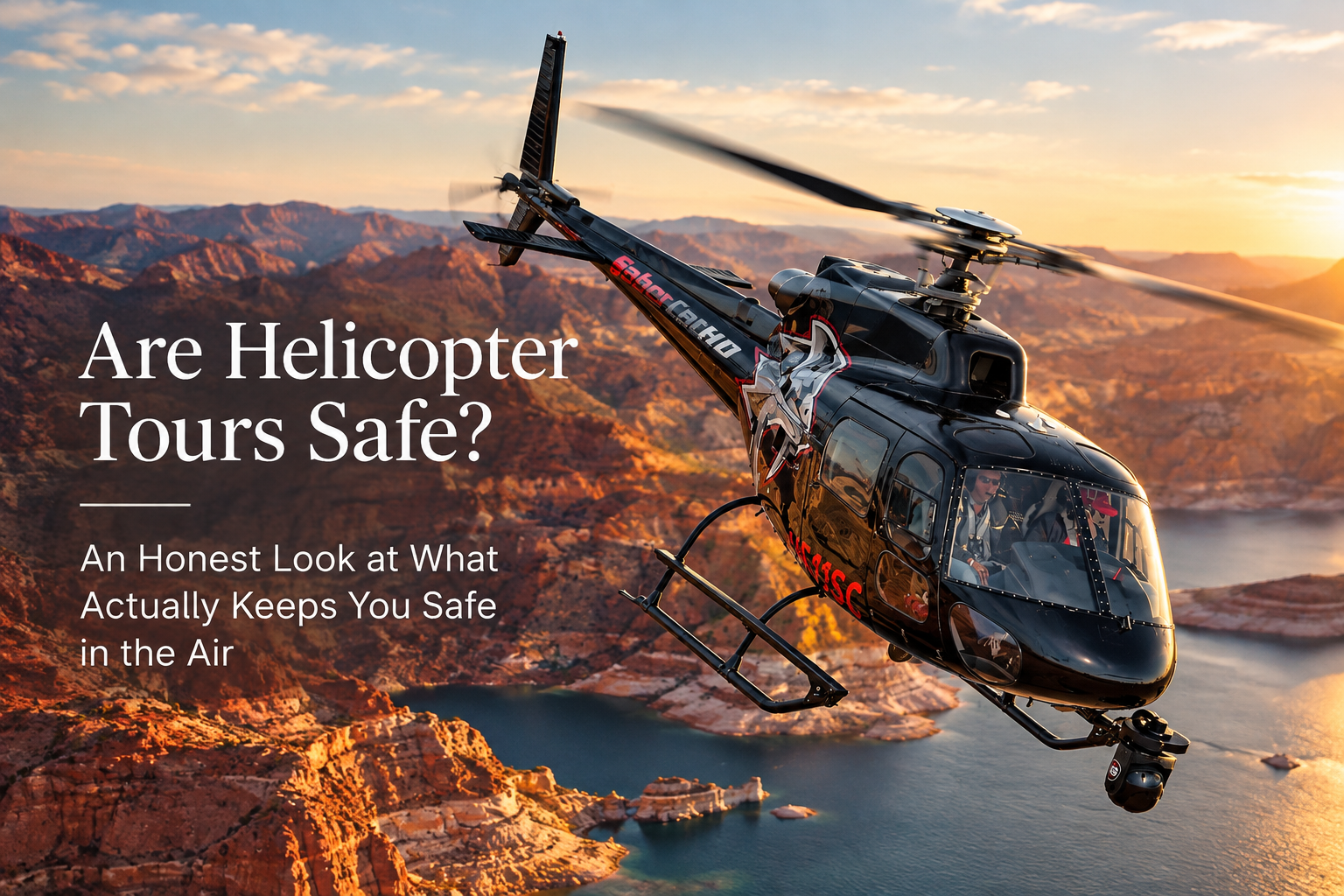
Our aircraft, an Airbus AS350-B2 A-Star we call SaberCat1, is one of the most widely flown turbine helicopters in the world, doing air medical work, law enforcement, utility operations, firefighting, and film work on nearly every continent. It earned that reputation by being powerful, stable, and durable, with strong performance in exactly what Arizona throws at an aircraft: heat, altitude, and long desert distances.
Running one aircraft rather than a fleet is often assumed to be a limitation. In practice it is a safety feature. SaberCat1 is maintained to the manufacturer’s program and FAA standards, and with one airframe and one crew, the people who fly it are the people who know it. It does not leave the hangar unless it is right.
The cabin seats up to five passengers with a total passenger weight limit of 850 pounds, and that limit is not a suggestion. Weight and balance gets tighter, not looser, in Arizona heat, so on certain flights the working limit is lower. If that means a group splits across two flights, that is what happens. The cabin is also fully air conditioned, a comfort feature in June and a clarity feature year round.
Private Flights Only: A Safety Decision Before It Is a Luxury One
Every flight we run is private. You fly with your own party and nobody else, which most people first hear as a comfort and status feature. It is, but the reason it started was operational.
Shared tours create pressure. Seats get sold to fill, weight becomes a puzzle to solve rather than a limit to respect, and schedules turn rigid because the next group is already waiting. If the weather toward the Mogollon Rim is not cooperating for a Sedona Experience, or the wind is wrong for a Mountain Top Landing, we can change the route, change the day, or simply say no without a domino effect through six other bookings.
The willingness to say no is the least glamorous safety feature in aviation and the most important one. We would rather move your Grand Canyon Experience than compress it into a day that does not deserve it.
What Safety Looks Like on the Ground at Scottsdale Airpark
Your flight starts in our private hangar at 16114 N 81st Street, adjacent to Scottsdale Airport, and the first part of it happens with the rotors stopped. You get a personal safety briefing covering how to approach and leave the aircraft, how the belts and headsets work, and what the first sixty seconds will feel like, and a crew member walks you to and from the helicopter.
Then the nerves evaporate faster than people expect. A helicopter lifting off is smoother than most elevators, and within a minute you are watching the Airpark shrink below you, the McDowells filling the window, and the Valley opening toward Four Peaks and the Superstitions. The question you asked in the hangar does not come back up.
Common Questions About Helicopter Tour Safety
Are helicopter tours safe? Yes. Commercial helicopter tours in the United States operate under FAA regulation covering pilot certification, aircraft maintenance, and operating rules. The most meaningful variable is the operator, so choose one with experienced pilots and a clear record. H5 flies with two pilots holding 55 plus combined years of experience and zero incidents.
What happens if a helicopter engine fails? Helicopters are designed to descend safely without engine power through a maneuver called autorotation, in which the rotor keeps turning on airflow alone and is used to cushion the landing. Every commercial helicopter pilot trains and is tested on it throughout their career.
Do helicopter tours get cancelled for weather? Yes, and a good operator cancels readily. Arizona weather is excellent for flying most of the year, but monsoon storm cells over the Phoenix Valley and the occasional winter system bringing low ceilings toward Sedona and the Grand Canyon will move a flight. Because ours are private, rescheduling is straightforward.
Is a helicopter tour safe for kids or older passengers? Generally yes. Seats are comfortable and the ride is smooth. Every passenger counts toward the weight limit, including children, so call us with your group and we will tell you exactly what works.
Is it scary? Far less than people expect. Takeoff is gentle, the cabin is quiet through noise cancelling headsets, and you can talk to your pilot the whole time. Nervous first time flyers are one of our favorite groups to fly, because the reaction when they land is unmatched.
Come See It for Yourself
The best way to get comfortable with this is to talk to the person who will be flying you. Call (480) 272-1100 or email info@h5helicopters.com and ask anything you want about the aircraft, the pilots, the weather, or the weight limits. You will get a straight answer.
When you are ready, the 1 Hour Adventure is the classic introduction to the Valley and the desert beyond it, and the Mountain Top Landing sets you down on a private desert summit no road reaches. For the flight people talk about for the rest of their lives, ask about the Grand Canyon Experience. Every one of them is private, flown by Mitch or Steve, departing from our hangar in the Scottsdale Airpark.